
How to Pay Off Debt: Strategies That Work for Real People
If you have debt and you feel a kind of paralysis about it, you are not unusual. The math is intimidating. The advice is conflicting. The plan you do not have feels worse than the debt itself, because at least the debt is quiet most of the time, and "where do I start" makes noise every time you sit down to think about it.
You have probably already heard the advice. Snowball, avalanche, consolidate, refinance, talk to a credit counselor. None of that advice is wrong. It is just incomplete.
The reason most people get stuck on debt is not because they picked the wrong method. They got stuck because they treated all debt the same when the debts behave very differently, or because they picked a method and quit it three months in when life got in the way.
I am a CERTIFIED FINANCIAL PLANNER® (CFP®) professional in Nashville. The version of debt advice I actually give clients is more boring than the internet's. It is also more useful. It is built around two questions: how much does each debt cost you in real dollars, and how much does each debt drain you in real attention?
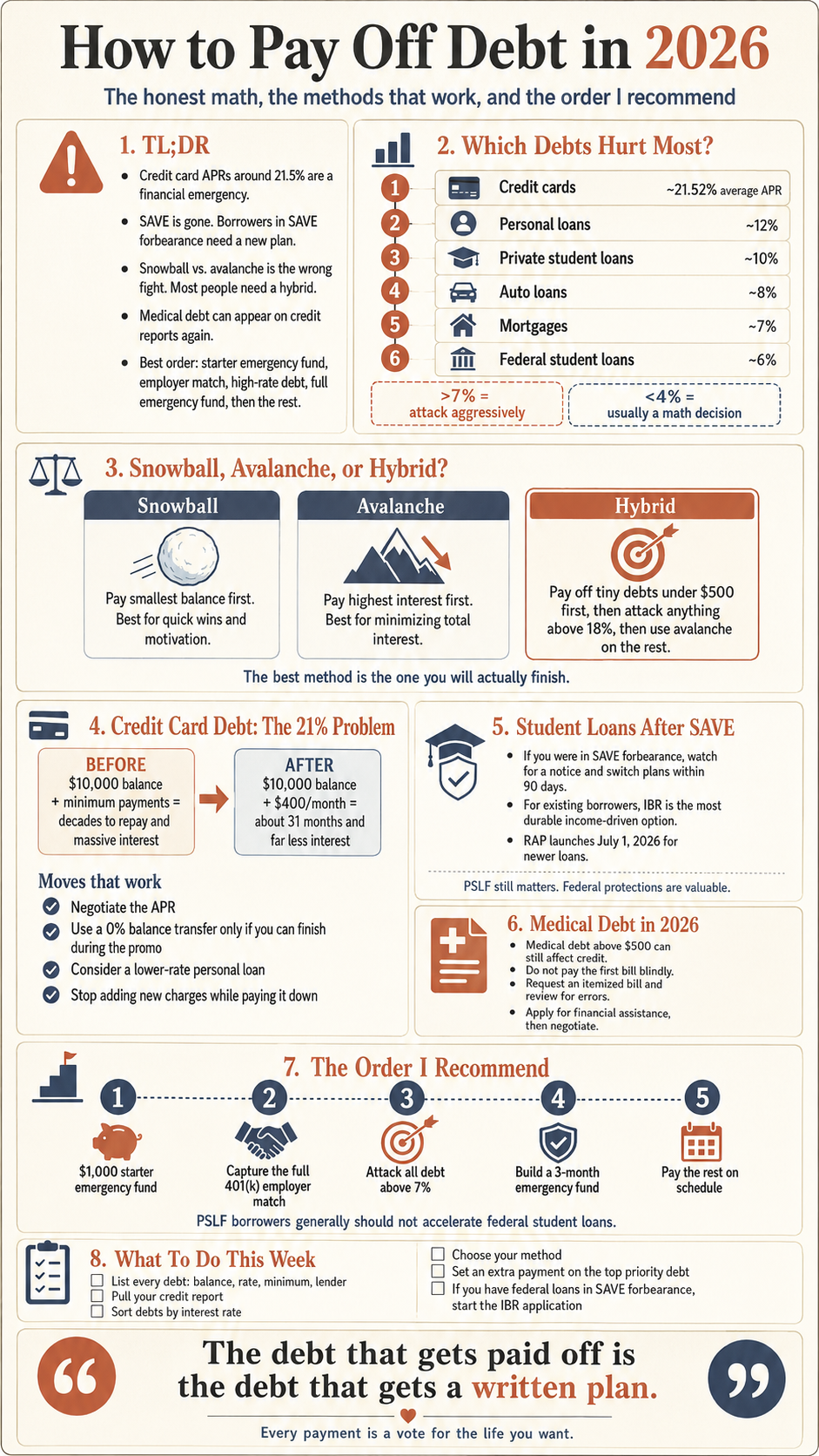
TL;DR
The average credit card APR was 21.52 percent on accounts assessed interest in Q1 2026 [1]. Anything in that range is a financial emergency disguised as a monthly bill.
The federal SAVE plan was vacated by a federal court on March 10, 2026 [2]. 7.5 million borrowers in SAVE forbearance need to switch to IBR, the new RAP plan (launches July 1, 2026), or another option within 90 days of receiving notice from their servicer.
Snowball vs. avalanche is the wrong fight. Most people need a hybrid. The bigger mistake is not picking a method at all.
The medical debt protection rule from the CFPB was vacated in July 2025 [3]. Medical debt can again appear on credit reports, which changes the negotiation calculus.
The order I recommend: emergency fund baseline ($1,000), capture any employer match, kill anything above 7 percent interest, build a 3-month emergency fund, then everything else.
The Honest Math: Which Debts Actually Hurt You
Not all debt is the same. Treating it like one undifferentiated pile is how people end up paying off a 5 percent student loan while a 24 percent credit card eats them alive.
Here is the honest math, by category, in 2026:
Credit cards. Average APR 21.52 percent in Q1 2026 on accounts assessed interest, 21.00 percent across all accounts [1]. Total US household credit card debt: roughly $1.25 trillion as of late 2025 [4]. Anything above 18 percent should be treated as an emergency.
Personal loans. Around 12 percent for solid credit, higher for weaker credit. Often used to consolidate credit card debt at a (sometimes) lower rate.
Auto loans. Around 8 percent for new cars, higher for used. Painful but not five-alarm.
Federal student loans. Around 6 percent depending on disbursement year. The interest rate matters less than the repayment plan and the forgiveness eligibility.
Private student loans. No forgiveness, no income-driven options, and rates around 10 percent. Treat closer to credit cards.
Mortgages. Average 30-year mortgage around 7 percent in 2026, depending on borrower profile. Tax-deductible interest in some cases. Generally the last debt to attack.
The first cut on any debt plan is simple: anything above 7 percent is an emergency. Anything below 4 percent is mostly a math problem about return on alternative uses of the dollar. The middle is where reasonable people disagree.
Snowball vs. Avalanche: Stop Picking a Side
The two most popular debt methods:
Debt avalanche: Pay minimums on everything, throw extra at the highest-interest debt. Mathematically optimal. Costs you the least in interest. Slower psychological wins because the largest interest rate often sits behind the largest balance.
Debt snowball: Pay minimums on everything, throw extra at the smallest balance. Mathematically inferior. Behaviorally powerful because you knock out small debts quickly and build momentum. A 2012 Harvard Business School study found that people are more likely to stick with the snowball method specifically because of those early wins [5].
The fight over which is "right" has been going on for two decades. The honest answer: it depends on which one you will actually finish. A method you abandon in month four costs you more than the slightly worse method you complete.
The hybrid I would recommend for most people:
Pay off any debt under $500 immediately, regardless of interest rate. Get the wins. Clear the noise.
Then attack any debt over 18 percent interest aggressively, regardless of balance. This is where the interest snowballs the wrong direction.
After that, you can run pure avalanche on the rest.
This combination gives you the early behavioral momentum of snowball where it actually matters (small annoying debts), the math advantage of avalanche where it matters most (high-rate balances), and a clean attack plan for everything else.
Credit Card Debt: The 21 Percent Problem
The single most common debt issue I see is credit card balances that have crept up over the years and gotten treated as a normal monthly expense.
The math is brutal. On a $10,000 credit card balance at 21.52 percent APR, paying just the minimum payment (typically 1 percent of balance plus interest), you would take more than 30 years to pay it off and pay over $20,000 in interest. The same balance paid down with a $400-a-month plan takes about 31 months and costs about $2,950 in interest. The math punishes the minimum-payment trap enormously.
A few real moves that work:
Call and negotiate the APR down. This actually works more often than people think, especially with longer-tenured cards. A 1-percentage-point reduction is worth real money over a year.
Move balances to a 0 percent APR balance transfer card, if you can get one. Most have a 3 percent transfer fee plus a 12-to-21-month promotional period. The math works if you pay the balance off during the promo. The math destroys you if you do not.
Personal loan to consolidate. Common 2026 rates for borrowers with good credit are around 12 percent. Cuts the rate in half compared to credit card APRs, even if the rate is still high.
Use the avalanche method specifically here. Highest-rate card first, minimums on the rest, extra everything you can find toward the top.
The hardest part is structural: stopping the bleeding while you pay down the balance. If the same cards that got you here are still in your wallet, the spending pattern that built the debt usually rebuilds it. Freeze them in literal ice if you have to. I am not being cute.
Student Loans After SAVE (The 2026 Reality)
The federal student loan system is in active transition in mid-2026, and the headlines have been confusing.
The short version: the SAVE plan, introduced by the Biden administration in 2023, was challenged in court almost immediately. It was placed in administrative forbearance for 7.5 million enrolled borrowers in mid-2024. The OBBBA legislation signed in July 2025 codified the end of SAVE, and a federal court formally vacated the SAVE Final Rule on March 10, 2026 [2].
What that means for you, if you have federal student loans in 2026:
If you were in SAVE forbearance: Starting July 1, 2026, your servicer will issue a notice giving you 90 days to enroll in a different plan. If you do not choose, you will be auto-enrolled in the Standard Plan or the new Tiered Standard Plan [6]. Months in SAVE administrative forbearance did not count toward forgiveness, so getting back into an active plan is the priority.
If you are choosing a plan for the first time: For loans disbursed before July 1, 2026, IBR is the most durable income-driven option. PAYE and ICR sunset July 1, 2028. For loans disbursed on or after July 1, 2026, the new Repayment Assistance Plan (RAP) is the only income-driven option, with payments set by statute at 1 to 10 percent of AGI and forgiveness after 30 years [6].
If you are pursuing Public Service Loan Forgiveness: Stay on an IDR plan. PSLF still requires 120 qualifying payments while working for a qualifying employer. Switching from SAVE forbearance to IBR resumes your qualifying payment count.
A tax note: Starting January 1, 2026, debt discharged through income-driven repayment is taxable again at the federal level [7]. Public Service Loan Forgiveness is still federally tax-free. This is a meaningful change for borrowers approaching 20 or 25 years of payments.
Generally speaking, for most millennial borrowers in 2026, the move is: get out of SAVE forbearance into IBR, keep working toward PSLF if you qualify, and treat federal student loans as the slowest part of the debt picture because the interest rates are usually the lowest and the forgiveness pathways have value.
Medical Debt (After the CFPB Rule Was Vacated)
For most of 2024 and 2025, medical debt looked like it was on its way out of the credit reporting system. The CFPB issued a final rule in January 2025 that would have removed medical debt from consumer credit reports entirely. Then a federal district court vacated that rule on July 11, 2025, before it took effect [3].
Where that leaves you in 2026:
Medical debt can still appear on credit reports. Unpaid medical bills under $500 are excluded by the major credit bureaus voluntarily, but anything above that can hit your credit if it goes to collections.
The negotiation room is still real. Hospitals and providers routinely settle medical debt for around half of the original billed amount, particularly if you negotiate before it goes to collections.
Itemized billing review is the first step. Studies have found error rates in hospital bills well above 50 percent in some samples [8]. Many of those errors favor the hospital.
Hospital financial assistance and charity care programs are required by law for nonprofit hospitals, and many people who qualify never apply because nobody told them about it.
The high-level move on medical debt: do not pay the first bill you receive. Get the itemized statement, dispute anything that looks off, apply for any financial assistance program the hospital offers, and only then negotiate the remaining balance. Paying it on day one is usually the most expensive option.
When the Math Says One Thing and the Behavior Says Another
The avalanche method is mathematically optimal. The snowball method is more durable in practice. The 0 percent balance transfer math is brilliant on paper and disastrous if you cannot pay it off during the promo. Refinancing a federal student loan to a lower rate is a math win that throws away forgiveness eligibility forever.
What I would recommend: when the math conflicts with the behavior, lean toward the behavior. The debt plan you finish in 36 months at 75 percent efficiency beats the optimal plan you abandon in 5 months at 100 percent efficiency. The compounding of consistency is real.
This is also why I almost never tell people to pause retirement contributions to pay off debt unless the debt is at credit card rates. The behavioral cost of breaking the savings habit is usually higher than the math saved by redirecting the dollars. There are exceptions. The default is to keep contributing at least enough to capture the full employer match and run the debt plan in parallel. The full order of operations across debt and retirement lays out where each dollar goes.
The Order I Recommend
The order I would generally recommend, in plain English:
Build a starter emergency fund. $1,000 in a savings account separate from your checking. This is the buffer that prevents the next unexpected expense from hitting a credit card.
Capture the full employer match in your 401(k). Even while you are paying down debt. The 100 percent same-year return on the match almost always beats the interest you would save by skipping it. The exception is if you have a 25+ percent APR credit card balance, in which case kill that first. (Not capturing the full match is the most common 401(k) mistake I see.)
Attack anything above 7 percent interest aggressively. Credit cards, private student loans, high-rate personal loans. Use the hybrid method described above.
Build a 3-month emergency fund. Once the high-rate debt is gone, fill the savings cushion before attacking lower-rate debt.
Run the rest on a standard payment plan. Federal student loans, mortgages, auto loans below 7 percent. Pay them down on schedule. Excess cash flow can go to investing, to extra payments, or to other goals.
That order moves around for some people. People pursuing PSLF should not accelerate federal student loan payments. People with deep behavioral problems around credit cards may need to cut them up before any other step. The order is a default, not a law.
What to Do This Week
If you read this far and do nothing, the post failed.
List every debt you have. Balance, interest rate, minimum payment, lender. On paper or in a spreadsheet. The list itself is half the work.
Pull your credit report at annualcreditreport.com (free, federally mandated). Confirm everything you owe and look for any debt that is not yours.
Sort the list by interest rate, descending. Anything above 18 percent goes in the emergency category.
Pick your method. Avalanche, snowball, or the hybrid I described.
Set a payment amount higher than the minimum on the top-priority debt. Even $50 extra a month materially changes the payoff timeline at 21 percent.
If you have federal student loans and have been sitting in SAVE forbearance, log into studentaid.gov this week and start the IBR application. Do not wait for the servicer notice.
The debt that gets paid off is the debt that gets a written plan. Everything else is hope.
What This Is Really About
Debt is heavy not because of the dollar amount on the spreadsheet. It is heavy because it narrows your choices. The trip you do not take. The career risk you cannot afford. The yes you say no to because the math will not let you. Every dollar paid down is a dollar you take back from that narrowing.
The point of having a plan is not to feel disciplined. The point is to stop carrying the question. The relief, when people finish the high-interest portion of the work, is rarely about the interest saved. It is about waking up and not thinking about it. Every payment is a vote for the life you actually want to live.
FAQ
Snowball or avalanche, which is better? Avalanche costs less in math. Snowball is more behaviorally durable. The hybrid I recommend pays off small debts first for momentum, then attacks anything above 18 percent regardless of balance, then runs avalanche on the rest.
Should I pay off debt or invest first? Always capture the full employer match in your 401(k), even while paying off debt. Beyond that, anything above 7 percent interest should generally be paid off before additional investing. Anything below 4 percent is usually a math case to pay on schedule and invest the excess. If you are deciding whether to invest while still carrying debt, the complete guide to investing for beginners is the place to start.
Is debt consolidation a good idea? Sometimes. The math case is strong if the consolidation rate is materially lower than the weighted average rate of the original debts and you do not run the original credit lines back up. The behavioral case fails for many people, who consolidate and then re-accumulate.
What happens to my SAVE plan student loans now? Starting July 1, 2026, your servicer will issue a notice giving you 90 days to enroll in a different plan. IBR is the most durable income-driven option for existing borrowers. RAP, the new income-driven plan, launches July 1, 2026.
Should I refinance my federal student loans? Only if you are confident you will not need income-driven repayment, PSLF, or other federal protections. Once you refinance to a private lender, those options are gone forever. For most millennials, the federal protections are worth more than a slightly lower rate.
References
LendingTree, "Average Credit Card Interest Rate in US Today." https://www.lendingtree.com/credit-cards/study/average-credit-card-interest-rate-in-america/
U.S. Department of Education, "SAVE Plan Transition Guidance, March 2026." https://studentaid.gov/announcements-events/save-court-actions
CFPB Medical Debt Final Rule and Vacatur Coverage. https://www.consumerfinance.gov/rules-policy/final-rules/prohibition-on-creditors-and-consumer-reporting-agencies-concerning-medical-information-regulation-v/
Federal Reserve Bank of New York, "Household Debt and Credit Report." https://www.newyorkfed.org/microeconomics/hhdc
Harvard Business School, "Winning the Battle but Losing the War: The Psychology of Debt Management." https://www.hbs.edu/faculty/Pages/item.aspx?num=42889
Federal Student Aid, "Income-Driven Repayment Plans." https://studentaid.gov/manage-loans/repayment/plans/income-driven
American Rescue Plan student loan tax provision sunset, IRS guidance. https://www.irs.gov/individuals/student-loan-discharges
Medical Billing Advocates of America, hospital billing error rates. https://billadvocates.com/
Federal Reserve, "G.19 Consumer Credit." https://www.federalreserve.gov/releases/g19/
Consumer Financial Protection Bureau, "What is a debt collector?" https://www.consumerfinance.gov/ask-cfpb/
Federal Trade Commission, "Debt Relief and Credit Repair Scams." https://consumer.ftc.gov/articles/coping-debt
IRS, "Topic No. 431, Canceled Debt." https://www.irs.gov/taxtopics/tc431
National Foundation for Credit Counseling. https://www.nfcc.org/
Bankrate, Credit Card and Personal Loan rate surveys. https://www.bankrate.com/credit-cards/news/interest-rates/
Experian, "What Is the Average Credit Card Debt?" https://www.experian.com/blogs/ask-experian/state-of-credit-card-debt/
U.S. Department of Education, "Public Service Loan Forgiveness." https://studentaid.gov/manage-loans/forgiveness-cancellation/public-service
I wrote a free guide called The Money Guide Nobody Gave You that walks through all five steps of building a financial foundation, including where high-interest debt fits in the order. Grab it here:
Or visit melbymoney.com/money-guide.
About The Author
Shaun Melby, CFP® provides fee-only financial planning and investment management services in Nashville, TN through his company Melby Wealth Management. Shaun has over 15 years of experience as a financial advisor in Nashville. Shaun created Melby Money to educate the public about finances.
Full Disclosure: Nothing on this website should ever be considered to be advice, research, or an invitation to buy or sell any securities. Please see the Disclaimer page for a full disclaimer.